Predictive monitoring shifts how teams handle potential failures in busy industrial settings. It spots tiny behavioral changes in equipment long before they turn into big problems. You get warnings early enough to act during normal hours instead of facing sudden breakdowns at awkward times.
Predictive monitoring relies on AI and continuous data streams. It watches assets closely. It alerts people to shifts that human eyes might miss during routine checks. In manufacturing plants where one stopped machine can halt an entire line, this approach matters a lot.
Server downtime eats profits fast. Server uptime keeps everything moving smoothly. Predictive monitoring sits right next to predictive maintenance but focuses more on detection and early alerts. It leaves the final decisions to experienced technicians who understand the full process.
What is Predictive Monitoring
Predictive monitoring tracks equipment performance in real time. It uses data patterns to forecast possible issues ahead of time. Sensors collect readings constantly. AI analyzes them against learned baselines of normal operation.
The system flags behavioral change that looks suspicious. A motor might start drawing slightly more current. Or vibration patterns could shift in a subtle way. These signals often appear days or weeks before actual failure.
Predictive monitoring differs from simple threshold alerts. Those only scream when something already crosses a hard limit. Predictive versions learn the unique rhythm of each asset. They notice deviations early even if values stay within old safety ranges.
Remote asset monitoring makes this practical across large facilities. You watch distant machines without constant physical presence. SCADA technologies often supply the raw data feed. Pressure, temperature, flow rates, and vibration all flow in continuously.
Asset management improves because you gain deeper visibility into each piece of equipment. Teams move from reactive firefighting to planned actions. Expert skillsets get used more effectively since the system narrows down where to look.
Honestly, older monitoring waited until something broke. Then chaos followed. Predictive monitoring gives breathing room.
Key Differences from Predictive Maintenance
- Predictive monitoring primarily detects and alerts on behavioral changes;
- Predictive maintenance goes further by recommending specific actions or timing;
- Many modern setups combine both for stronger results;
- The human intermediary stays essential. AI spots patterns but lacks full plant-floor context.
How Predictive Monitoring Works
Data collection forms the foundation. Sensors attached to critical machines capture high-frequency readings. Vibration. Temperature. Current draw. Oil condition. Flow rates. SCADA technologies pull this information together into one usable stream.
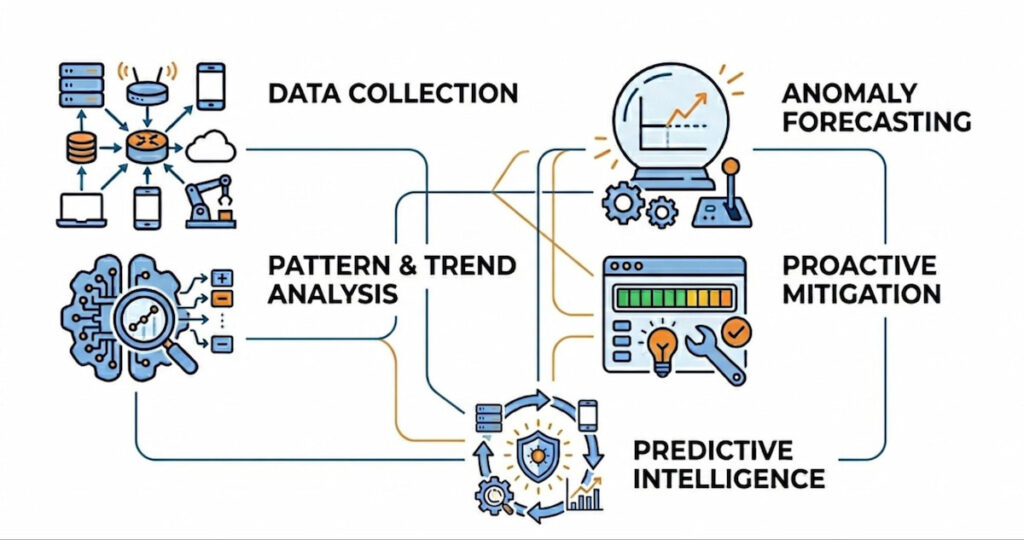
AI takes over next. Machine learning models study historical data first. They build detailed baselines for each asset under different operating conditions. What counts as normal on a busy Monday differs from a quiet weekend shift.
When live data drifts from these baselines, the system notices immediately. A small but consistent change in vibration frequency might indicate early bearing wear. The AI flags it without waiting for dramatic failure.
Alerts reach the right people. Sometimes the notification simply highlights the behavioral change. Technicians then apply their expert skillsets. They decide the best response based on full operational knowledge.
Root cause isolation becomes faster. The system often points toward the likely source so teams avoid tearing down unrelated parts. This saves time and reduces unnecessary work.
Some advanced predictive monitoring setups add forecasting. They estimate the remaining useful life. “This component shows wear signs. Expect issues in about 10 days unless addressed.”
The process runs continuously. Fresh data keeps retraining the models. Accuracy improves over months as the system learns your specific environment.
Main Stages in Simple Terms
- Sensors gather raw data from assets;
- SCADA or similar systems centralize the information;
- AI compares live readings against learned baselines;
- System detects anomalies or behavioral change;
- Alerts go to technicians with supporting details;
- Human experts investigate and decide on action;
- New data refines future predictions.
Benefits of Predictive Monitoring
Teams notice real gains once predictive monitoring settles in. Server downtime drops fast. Unplanned stops in manufacturing wreck schedules and burn money. Early warnings now let you fix issues during normal maintenance windows instead of chaotic emergency shutdowns.
Server uptime climbs higher. Machines run longer without sudden deaths. Plant reliability and production reliability both improve. Maintenance costs fall in several ways at once. You dodge expensive rush repairs and overtime. You skip pointless work on healthy equipment. Spare parts inventory turns smarter and tighter.
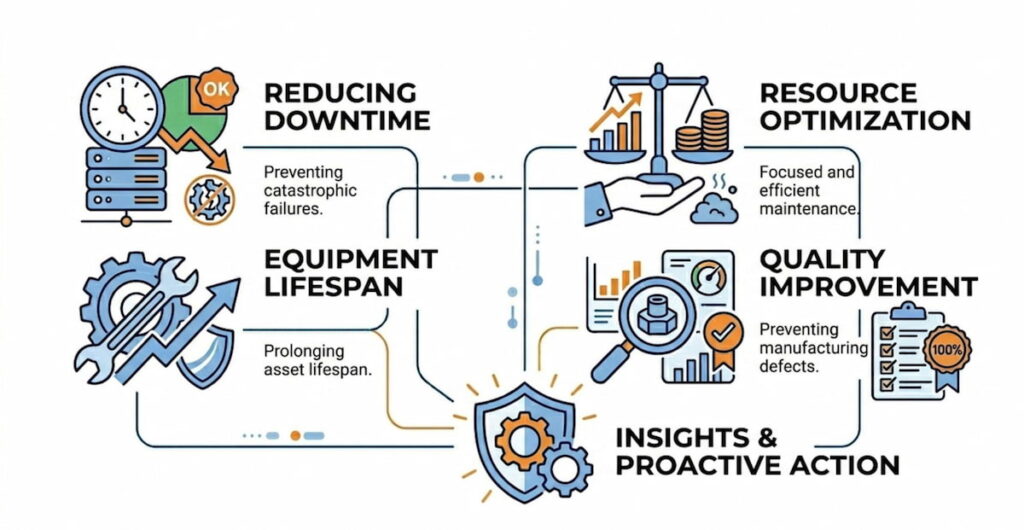
Safety gets better too. Hidden problems appear before they threaten workers. Remote asset monitoring cuts travel time so one skilled team can watch multiple sites. Asset management grows deeper. Equipment lasts longer. Energy use sometimes drops when inefficient behavior gets caught early. We think the quietest win is reduced stress. Fewer 2 a.m. calls leave crews more rested and operations far steadier.
Quick List of Benefits
- Lower unplanned server downtime;
- Higher overall server uptime;
- Reduced maintenance and repair costs;
- Extended equipment life;
- Improved safety on the plant floor;
- More consistent product quality;
- Smarter use of spare parts and inventory;
- Better allocation of technician time.
How to Implement Predictive Monitoring: Step-by-Step
Start small to build momentum. Pick one or two critical assets that cause the most pain when they fail. Success in a pilot area makes expansion easier.
Step 1: Assess Your Assets
List all key equipment. Rank them by criticality, failure history, repair costs, and impact on production. Focus first on bottlenecks or high-value machines in manufacturing.
Step 2: Build Data Foundation
Install appropriate sensors where gaps exist. Ensure SCADA technologies or existing control systems deliver clean, reliable data. Poor data quality ruins predictions.
Step 3: Select Tools and Platform
Choose a predictive monitoring solution that fits your current setup. Look for good AI capabilities and integration with SCADA. Test compatibility carefully.
Step 4: Establish Baselines
Run the system in observation mode for days or weeks. Let AI learn normal patterns under real operating conditions. Rushing this stage creates noisy alerts later.
Step 5: Configure Alerts and Dashboards
Set up notifications that reach the right people at the right time. Keep messages clear and actionable. Include enough context so technicians know where to start investigating.
Step 6: Train the Team
Teach technicians how to interpret alerts. Help managers understand reports for better asset management decisions. Address any skepticism early.
Step 7: Expand Gradually
Add more assets once the pilot proves reliable. Adjust models with new data. Review performance monthly and fine-tune thresholds.
Step 8: Maintain and Improve
Schedule regular reviews. Update sensors as needed. Retrain AI models when processes change. Expect ongoing effort rather than a set-it-and-forget-it system.
Implementation takes patience. Every plant runs differently, so some tweaking always happens. Budget for both initial setup and continued refinement.
Examples of Predictive Analytics
Predictive analytics drives many useful applications inside predictive monitoring.
CNC Machine Spindles
Vibration sensors track bearing conditions. The system spots rising amplitude or frequency shifts that signal wear. Technicians replace bearings during planned stops instead of facing sudden failure mid-run.
Conveyor Systems
Acoustic and vibration data monitor rollers. Uneven wear creates detectable noise or vibration changes. Early replacement prevents jams that stop entire production lines.
Motors and Pumps
Temperature and current draw trends reveal developing issues. A slow rise might indicate poor lubrication or misalignment. Fixes happen before burnout occurs.
Hydraulic Systems
Oil quality sensors measure particle counts and viscosity changes. AI flags degradation that points to upcoming seal or component failure.
Compressors Across Multiple Buildings
Remote asset monitoring lets one team watch units in different locations. Power draw anomalies trigger checks that often reveal simple issues like dirty filters.
Ovens and Mixers in Food Production
Consistent temperature monitoring keeps product quality high. Deviations get caught before entire batches go wrong.
These examples show how predictive analytics turns raw sensor data into practical foresight. SCADA technologies supply the numbers while AI makes sense of them.
How to Choose Predictive Monitoring
Selecting the right predictive monitoring solution requires careful thought. Not every tool fits every plant.
Important Factors to Consider:
- Compatibility with Existing Systems — Does it work smoothly with your SCADA technologies and current asset management software?;
- AI Capabilities — Look for models that learn your specific patterns rather than applying one-size-fits-all rules. Request demos with your own sample data if possible;
- Scalability — Start small but choose a platform that can grow across the full facility or multiple sites;
- Alert Quality — Strong solutions filter noise effectively. You want exception-based notifications that reduce false alarms;
- Ease of Use — Dashboards should feel intuitive for both technicians on the floor and managers reviewing reports;
- Integration and Support — Check how well it connects to your CMMS or ERP. Good vendors provide solid training and ongoing help;
- Cost Structure — Look beyond initial price. Factor in sensors, data storage, model maintenance, and any computing requirements;
- Security — The system handles sensitive operational data. Make sure it meets your manufacturing cybersecurity standards;
- Industry Experience — Tools proven in similar industrial manufacturing environments often adapt faster.
We think running a small trial on one or two assets gives the best insight. See real results in your own environment before committing fully.
Talk to other users in comparable plants. Their experiences often reveal practical strengths and weaknesses that marketing materials skip.
Predictive monitoring requires some upfront effort and patience. Once running well, it delivers quieter shifts, fewer surprises, and more reliable output.
The approach continues to improve as AI techniques advance and remote asset monitoring grows stronger. Yet the fundamentals stay consistent: good data feeds, smart analysis and human judgment guiding final actions.
Predictive monitoring gives manufacturing operations a real edge, less server downtime and more server uptime. Stronger plant reliability and production reliability. Teams shift focus from constant firefighting toward steady improvement.
Start where pain hits hardest. Build from proven wins. The results show up in smoother days and more predictable performance.